↓
 

Dallas Civil Engineering

...a DHR Engineering marketing website.

Dallas Texas - Dallas County Courthouse
Dallas Civil Engineering
(214) 251-4070
Dallas Civil Engineering
  • Home
  • Civil Engineering
  • Construction Management
  • Drone LiDAR Mapping
  • Environmental Engineering
  • Expert Witness
  • Land Development Services
  • Land Surveying Services
  • Structural Engineering
  • Transportation Engineering
  • Blog
Home - Page 3 << 1 2 3 4 5 … 10 11 >>

Post navigation

← Older posts
Newer posts →

The Hydrologic Unit Modeling for the US (HUMUS)

hydrologic unit watershed modeling dallas tx

According to Wikipedia, the Hydrologic Unit Modeling for the United States (HUMUS) is a national-scale hydrologic modeling system developed by the USDA Natural Resources Conservation Service to evaluate water quantity and non-point source pollution across the United States. It integrates the Soil and Water Assessment Tool (SWAT), Geographic Information Systems (GIS), and extensive environmental databases to simulate watershed processes within 8-digit hydrologic units. HUMUS supports water resource planning, conservation, and environmental impact assessments by analyzing the effects of land use, climate, and management practices on watershed hydrology.

Posted on July 27, 2026 by DallasCEJuly 24, 2026

Reinforced Concrete Slabs in Structural Engineering

Civil engineer inspecting steel reinforcement and formwork for a concrete slab at a construction site in Dallas, Texas.

According to Wikipedia, a concrete slab is a flat, horizontal structural element made of cast concrete that is widely used in the construction of floors, ceilings, roofs, and pavements. In structural engineering, reinforced concrete slabs are strengthened with steel reinforcement to improve their ability to resist tensile forces, increase durability, and safely support applied loads. Slabs are one of the most important load-bearing components in buildings because they transfer loads from occupants, furniture, and equipment to beams, columns, and foundations.

Concrete slabs are generally classified as ground-bearing slabs, which rest directly on the ground or foundation, and suspended slabs, which are supported by beams, columns, or walls above ground level. In multi-storey buildings, several slab systems are commonly used, including beam-and-block slabs, hollow-core slabs, and cast-in-place (in-situ)reinforced concrete slabs. The selection of a slab system depends on factors such as building type, structural loading, construction method, cost, and span length.

In engineering practice, reinforced concrete slabs are designed to withstand bending moments, shear forces, and deflection while meeting safety and serviceability requirements. Structural engineers use design codes and computer-aided design (CAD) software to calculate reinforcement requirements, slab thickness, and load capacity to ensure the structure performs safely throughout its service life.

Posted on July 24, 2026 by DallasCEJuly 23, 2026

Reinforced Concrete

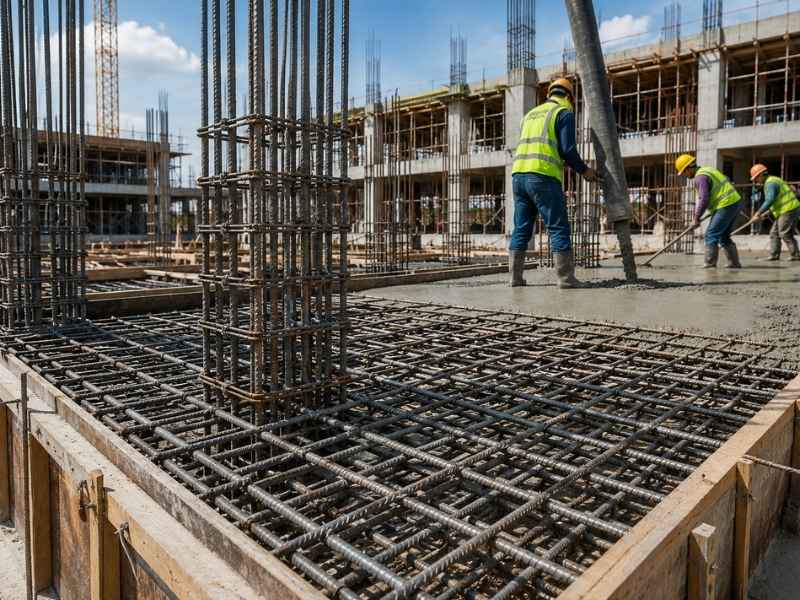
Reinforced concrete slab with steel rebar, column reinforcement, and fresh concrete being poured at a commercial construction site.

According to Wikipedia:Reinforced concrete (RC), also known as ferroconcrete, is a composite construction material made by combining concrete with steel reinforcement bars (rebar), steel mesh, or other reinforcing materials. Concrete is very strong in compression but relatively weak in tension. The embedded steel reinforcement provides the tensile strength needed to resist cracking and structural failure, making reinforced concrete one of the most widely used materials in modern construction.

The steel reinforcement is placed inside the concrete before it hardens, allowing both materials to work together under loads. In some structures, reinforced concrete is also prestressed using pre-tensioning or post-tensioning techniques to improve its performance and increase its load-carrying capacity. When properly designed, the alkaline environment of concrete helps protect the embedded steel from corrosion, contributing to the durability and long service life of reinforced concrete structures.

Reinforced concrete is commonly used in the construction of buildings, bridges, dams, highways, tunnels, foundations, retaining walls, and many other infrastructure projects because of its strength, durability, fire resistance, and versatility.

Posted on July 22, 2026 by DallasCEJuly 21, 2026

Post navigation

← Older posts
Newer posts →

Contact Us


© DallasCivilEngineering.com
4131 N Central Expy Suite 900
Dallas, TX 75204
Phone: (214)251-4070
...a DHR-Engineering marketing website.
(TX Firm #9184)

Web Development and SEO by:
Southern SEO

Privacy Policy | Terms of Use

The owner of this website provides coordination of professional engineering services in all 50 states. The professional engineering services provided to you will be conducted by fully licensed professionals in Texas.

Follow Us
&nbsp Privacy Policy
↑